Expert Solutions
In the final year of my degree (1995), the university started a new elective class called Empreendimentos em Informática. The professor was someone very involved with the entrepreneurship movement. The idea behind the class was to prepare students to start their own companies — something very close to the concept of a startup, though we weren’t using that name yet. The assignments consisted of interviewing entrepreneurs, studying real cases, writing business plans, and designing the complete operation of a fictional company. The final project would be exactly that: a complete business plan. There would be a contest among the groups in the class, and the top three would win a booth at two major Brazilian computing trade fairs: Inforuso in Belo Horizonte, and Fenasoft, in São Paulo.
My group consisted of me, Tim, and Rick — who would later become my partners at Expert Solutions Informática Ltda. Since Tim was studying Foreign Trade alongside computing, he suggested we build software to solve some of the problems faced by companies doing international trade. He had already noticed that there was a lack of systems to help companies automate their foreign trade paperwork: forms, documentation, and bureaucratic processes. So we built the whole business plan around that. We did research, studied how the sector worked, and made everything look nicely polished.
When the day of the final presentation came, I was chosen to present. I did my best and we ended up in third place. That meant we’d get a booth at both fairs, about three months later. There was just one problem: we’d have to develop a substantial piece of software in three months. We did end up talking to a businessman, a friend of one of Tim’s relatives, who offered to invest in the company. But he wanted 51% of the shares, and we were afraid of losing control. Today, looking back, maybe that was the company’s death sentence.
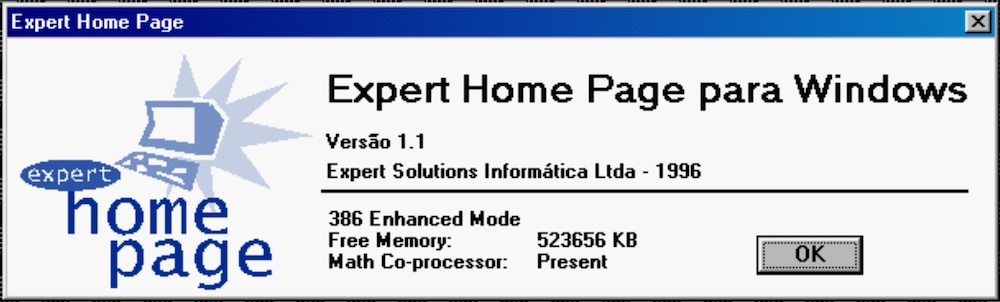
Since time was way too short, we needed a simpler initial product. That’s when I had the idea: build a piece of software that would help anyone set up their own home page — as we called web pages back then. With some effort in Visual Basic, the Expert Home Page for Windows was born.
With the software ready, we had to think about how to sell it. At the time, software was sold in stores, in little boxes with floppies inside. A friend of my brother’s, a student in the Advertising program, was hired to create the company’s logo and the artwork for the box. We had them printed at a print shop, prepared envelopes for the floppies, and on the weekends leading up to the fairs, I took stacks of boxes over to my grandmother’s house. My cousins helped fold, assemble, and package everything. In the end, we had a reasonable quantity of little boxes ready.
At the fairs, though, we were placed in low-traffic areas. We sold a few copies, but nothing significant. We spent most of the time chatting with neighboring exhibitors. Customers were rare. Still, we tried to scale up sales of the software. Tim got in touch with the owner of a software distributor in Belo Horizonte and we signed a contract — but the distributor kept almost half of the sale price. The profit was small.
Then we tried another strategy: have the software included in computing magazines, the kind that came with CDs full of programs. Nationwide distribution could bring in some money if we could get a few reais per copy. But the deal didn’t go through. The magazine published the software anyway — that is, we were pirated on a national scale, with no way to push back. Filing a lawsuit was out of our reach.
We also set up an online sales operation. We rented a PO box, bought a cell phone (a Motorola tijolão, a “big brick”, expensive by the standards of the time), and created a kind of virtual company, which was unusual at the time. The website took orders, we’d send the price, ask for a bank deposit, and mail the little box. It worked, but it was amateurish. At that point, Rick was practically alone running things: I was in Campinas doing my master’s, and Tim had his own commitments. He held things together as best he could.
It was then that Netscape launched a built-in HTML editor inside Netscape Navigator Gold Edition. It was infinitely better than our wizard-based solution. And for many users, it was free. There was no way to compete. It became clear that Expert Home Page wouldn’t survive.
And so Expert Solutions slowly faded — not from bankruptcy, but from abandonment. Each of us went our own way. The company continued to exist formally for a few years, almost always inactive. I did use it as my business entity for a few jobs, but that no longer had anything to do with its original purpose.
That’s how my entrepreneurial adventure came to an end.
Notes:
- A curious detail: A site built with Expert Home Page was still online in November 2025: https://mosqueteiro.tripod.com/
- Watch a video of Expert Home Page in action.
Advice nobody asked for but I’m writing down anyway:
- I think the big lesson from Expert Solutions is the need to take risks and to be fully dedicated if you want a company to take off. In our case, the three partners all had other plans that we didn’t want to change in order to commit to the company. The fear of losing control to a majority partner also made us pass on a rare opportunity, instead of negotiating with the investor. There was a possible synergy, with the investor bringing his business experience and us bringing our technical capability.