Internet without Web
The internet we had at the university was slow, very slow, but finally an upgrade was made to the link connecting UFMG to the rest of the world. We moved up to a 64 kbps link, much better than the previous one. Today, a cell phone with no signal is probably better connected.
Regardless of that upgrade, I started an internship in the IT department of the Faculty of Language Arts. The work was simple: help professors and staff use Microsoft Word and solve everyday minor issues. Of course I brought along my favorite antivirus programs and started cleaning the computers, while also growing my sample collection. I even gave a little antivirus mini-course. Since hardly anyone had Windows, everything was done on the DOS command line, which for many seemed like rocket science. In the end, I prepared an instruction sheet with the commands exactly as they should be typed. People just copied the letters, without really understanding what they were doing, but it worked.
That internship also gave me access to the university’s mainframe, which was connected to the Bitnet network. We didn’t know how to do much on Bitnet, but you could send emails and take part in a pretty lively chat. We’d spend hours and hours typing with people from other universities, people we had never met and would probably never see again.
If it’s already hard today to imagine an internet without the web, try to imagine an internet without Amazon. Amazon was only born in 1994, when I was already halfway through my degree. In the beginning, there was no easy way to buy books or get up-to-date materials. When something was available online, we figured out a way. For everything else, it was through photocopies. It was common to see students with stacks of photocopied chapters because there simply was no way to buy the book in Brazil in a reasonable time (and it was also very expensive).
Around late 1992, some people at the university discovered Book Stacks, one of the first online bookstores, which worked by email. The system was primitive, very artisanal, but it broadened our horizons. Suddenly, we had access to the American book market. For anyone studying computing, that was wonderful: it let us keep up with the state of the art without depending on some Brazilian bookstore’s goodwill to import a single copy at gold prices, or on waiting for someone to travel abroad and bring a book back in their suitcase.
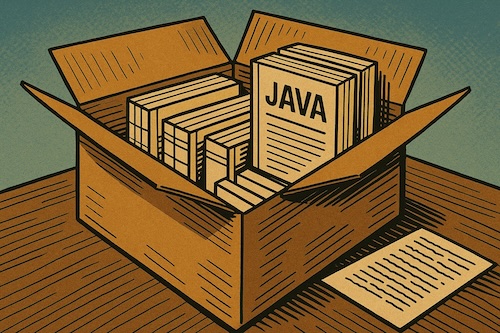
The shipping was expensive, sometimes more than the book itself. On the other hand, there was no import tax on books. To reduce shipping costs, the strategy was to get a big group together and do a collective order. I remember organizing one of these buys: I rounded up the crew, collected the money, ordered about twenty copies, and had them delivered to my house. Then I spent days handing out book after book to my colleagues. It was a lot of work, but it was worth it. For the first time, we had immediate access to the most important news in our field, without waiting months for someone to travel and bring a copy in their luggage. In my case, it was one of the first books on the Java programming language.