Freshmen
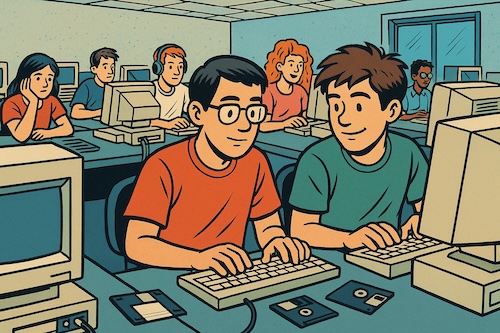
After my internship at IBM, I passed the university admissions exam and, in 1992, I started university, studying Computer Science at UFMG. I had done really well on the exam and came in feeling like hot stuff. Even so, it was a period of adjustment: new classmates, new professors, more freedom, more independence, and of course a much higher level of difficulty.
I had already been programming in Pascal for some time, and since the introductory programming courses used that same language, I imagined it would be easy. And it was, at least at first. But the shock came on the first exam, when I wrote some code full of break, goto, and exit — something that looked more like BASIC than Pascal. The professor used my program as a negative example for the whole class. It was a double lesson: about humility and about good practices. I learned to structure my code better, and the whole class moved on to new topics like data structures and other foundational computer science concepts.
Besides improving my Pascal, getting into university brought me something even more important: internet access. At the time, very few people had it at home. Some could connect to systems like BBSs, where you could exchange messages and files and download programs, but in a very limited way. BBSs weren’t 100% online: data was accumulated during the day and transmitted at night, from server to server. It was slow and more like exchanging letters than the instantaneous communication we have today.
At home, we didn’t have a modem, so I had never been able to access anything online. Having internet at the university was wonderful. Even so, the connection was slow and shared with all the University. Oh, and let’s not forget: the web didn’t exist yet. We used telnet, FTP, Gopher, and email, but there was no browser. At first, few people knew what this internet thing was, and the few in the know gathered in the computing labs to explore. Over time, the group grew, and the network got more and more congested.
It was in that environment that I discovered the online BBSs reachable over the internet itself. They let you interact with all kinds of people from all over the world. It was an informal kind of learning, full of novelty. With some classmates, we discovered MUDs (multi-user dungeons), online RPG games where dozens of people could play together. We were used to single-player games or at most two people with two joysticks connected to the same console or computer. Playing with dozens of friends or strangers was something revolutionary.
With access to BBSs, MUDs, and FTP for downloading software, there was always a group of students who spent more time in the labs than in class. The network became unsustainable. The administrators decided to “hide” the most-used network programs, mainly telnet and FTP. But by then we were starting to understand the system a bit better and one colleague found out that the executables were still there, they’d just been blocked (no exec permission). We each made a copy, renamed the file, and kept using them, sure that no one would find out. Of course they found out. We were called in for a talk with the sysadmins and warned to respect the network usage rules. We left without really understanding how the admins had caught us: it would still take a while for us to learn that it wasn’t actually that hard.
With no telnet and no FTP, we were left only with email. So I started exploring what I could do with it, and I discovered a whole world of mailing lists. And I got access back to the famous Virus-L, where researchers from all over the world swapped articles and debated computer viruses. I already had a track record of interest in the topic, so diving into that environment was fascinating. The amount of information was enormous and unlike anything in the library: news and discoveries freshly published, still being consolidated.
Another thing I learned was how to download files over email. It sounds odd, but it worked: you’d send a message to a server’s email address with the details of the file you wanted, and it would FTP it for you and send the content back by email. That’s how I downloaded articles and, most importantly, antivirus updates.
Of course the lab was also used for coursework. Between a BBS session, a MUD, and a little ftp, we programmed. Students were constantly swapping floppies to save their projects, and some computers already had a hard drive, which was a luxury at the time. With so much floppy swapping, viruses showed up often, and keeping the antivirus up to date was essential — for me, at least.
Until one day a different kind of virus showed up. But that story is for the next chapter.