The Last Semester
In the final semester of my program, it was time to take some electives and start thinking about next steps. I’d picked three classes that sounded very interesting: multimedia systems, topics in computer science, and robotics. By then, we had started working on the Expert Solutions project, and I had signed up for one more course than I needed. Things were getting really heavy, so I ended up dropping robotics. It was a good call for keeping the stress of my final year a bit more under control.
In the multimedia class, the professor was entirely focused on HTML. It was still a pretty new, evolving technology, and it was already starting to show signs that it could become an option for building multimedia systems. I think he was right about the future, but at the time, the technology wasn’t mature enough yet to let you build genuinely multimedia systems with HTML pages. My group’s project was to create a virtual tour of the Institute’s building. The idea was to take photos of the hallways and build a system kind of like Google Street View: clicking the center of the photo would move you forward, while clicking on one of the sides would turn you in that direction. If we took photos at every intersection, you could navigate the whole building. In the end we only did a small stretch — it was too many photos, and it was much more work than we had imagined. At that time, we still didn’t have access to digital cameras, so you had to take the photo, get it developed, and then scan it.
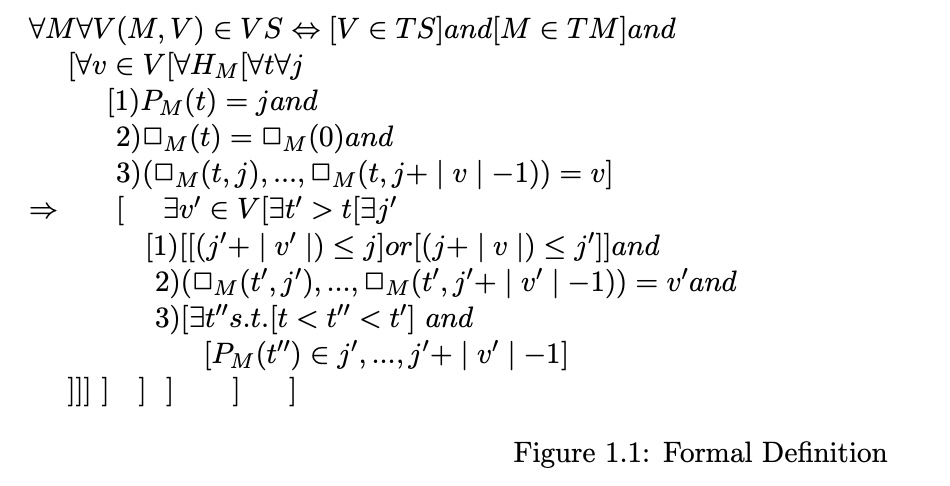
The other class was topics in computer science, with Professor Bauer, the same professor from the virus story. That course dealt with a mix of subjects that were trendy at the time. The professor let the students suggest topics, then split us into groups, and each group presented one of them. The two topics I remember were viruses and ATM networks. Viruses were still a somewhat supernatural thing back then. People knew they existed, knew they were a problem, but few really understood how they worked. For that course, I managed to buy Fred Cohen’s book, A Short Course on Computer Viruses, and I used the book to prepare my presentation, including a slide with the mathematical definition of a computer virus (the figure at the top of the page). It was a way to make an impression. It must have worked, because the professor copied my slide and started using it in his own presentations. The other topic, ATM networks, represented one of the latest trends in computer networking and, in that context, was closely associated with the move toward optical fiber as a physical medium.
I was also still doing my undergraduate research, which was loosely related to cryptography. I wanted it to be more related to cryptography, but there was no one who could advise me in that area. My interest, which had started with PGP, led me to look for more material, and that’s how I discovered the work of Bruce Schneier, including his book. It was my first cryptography book. A few years later, I discovered that the academic world had reservations about the lack of formalism in Schneier’s work, but back then it was the best possible reference for me to start learning the math behind the algorithms. Since Schneier also wrote about information security in general, I began to follow his work, which broadened my horizons and introduced me to aspects of the field I didn’t yet know.
Image source: Cohen, Frederick B. A Short Course on Computer Viruses. 2nd ed., Wiley, 1994.