Bits in 3D
While taking care of the university paperwork, I also started looking for an advisor — an essential step in a master’s program. I already knew Unicamp had a strong research group in security and cryptography, an area that had appealed to me since my bachelor’s degree. The graduate coordinator pointed me to professors Paulo Lício and Ricardo Dahab. I went to talk to both.
The conversation with Professor Ricardo Dahab clicked immediately. He led the institute’s cryptography group. That meeting ended up setting the course of my academic life: I had found my advisor.
Around that time, a curious coincidence brought me closer to a classmate who would become an important reference to me: Pagliusi. Sometime before the move, I had read a message from him on an international mailing list about security or cryptography. I noticed the email was from Unicamp and that he was looking for the PGP source code, which at the time still faced export restrictions. Since I already knew the story of the book used to get around the ban, I replied pointing out that the code was available at ftp.funet.fi, a popular European FTP site at the time. I took the opportunity to mention that I had been accepted into Unicamp’s Computer Science master’s program.
Being the kind guy he is, he struck up a conversation right away. He asked about my plans, gave me tips about the city, and told me to look him up when I arrived. And indeed, during my first days in Campinas, I went to find him. He helped me with information about housing, the department, and the academic environment. He was the first person at the Institute of Computing I met — even before we knew we would end up in the same research group.
Pagliusi’s master’s project was to integrate PGP with Emacs and allow encrypted email. Without access to the PGP source code, he couldn’t move forward; so finding it was essential to unlock his work. During the master’s program, we talked a lot about PGP, cryptography, and countless other topics. Pagliusi, without meaning to, also ended up providing the cryptography group with one of the strangest and most memorable experiences of my time at Unicamp.
Somehow, he was contacted by a guy who claimed to have invented a new cryptographic algorithm and who wanted Unicamp’s help to validate his work. Since Pagliusi was very sociable and always saw the best in people, he ended up organizing a talk and inviting the algorithm’s author to present it to the students and professors of the crypto group.
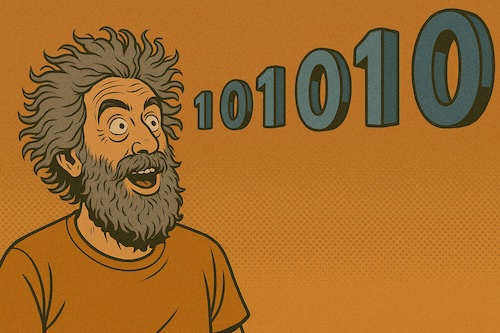
When this “author” showed up and started speaking, it was easy to tell he was completely nuts. He began by telling the story of how he’d invented the algorithm: he started seeing bits in 3D, and it was when he saw the bits from behind that he had the idea for the algorithm. He spent the whole talk explaining the whole “bits from behind” business, but said nothing about the algorithm itself.
When he finished his presentation, the first question came: “But how does your algorithm work?” His answer: “But if I tell you, you might copy it.” By the end of the night, we had learned a lot about seeing bits in 3D, but nothing about cryptography…