Unemployed
On April 2, 2001, right after we got the email saying Intelligenesis had gone bankrupt, my colleagues and I were all still in the office, not quite sure what to do. It was a shock. While some people were talking about ending the day at a steakhouse (one of the famous Brazilian churrascarias), I got in my car and drove straight home. After all, I had a family to support, a new mortgage, and my second child was only a few months old.
When I got home in the middle of the afternoon, Gisele asked me, in a tone somewhere between concerned and joking: “Why are you home so early? Were you fired?” I don’t know if she has a sixth sense or if it was just a coincidence, but I don’t think she was expecting me to answer “yes.” I spent the rest of the afternoon with my kids and, after we’d put them both to bed, we sat down in the living room to talk and figure out what to do next. Since I had gotten a raise for the move to BH and we’d saved most of that raise during the three months since the move, we had a small reserve that would let us survive for a while. The important thing was to start looking for another job right away.
We were so focused on that conversation that at one point I realized I needed to let my mother know what had happened. After all, both her sons had lost their jobs on the same day. Only after I’d called and she picked up did I realize it was already late at night. She was startled when the phone rang and thought it was bad news. It turned out that our layoffs were better news than what she’d feared.
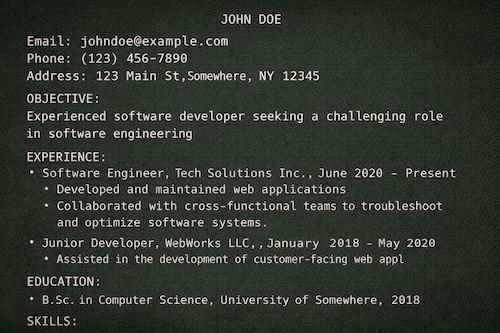
The very next day, I started reaching out to see if I could find a new position. I put together a resume and asked my friend Tim, who worked at the company TIM, to take a look and see if he could help. His first piece of feedback was that the resume was hideous. Like a good security professional, I had decided I couldn’t make the resume in any format that could carry malware. I couldn’t make it in DOC or PDF, so I went for the most obviously secure format: I made my resume in TXT format. That format has no fonts, formatting, or any other way to prettify the final result. Based on his feedback, I grabbed Word and made a nicer-looking resume.
At the same time, Gisele also started talking to her contacts. Through friends, we found out BMS, the IT shop of Grupo Belgo-Mineira, was hiring. She sent my new, prettified resume to Júnia, who forwarded it to one of her contacts at BMS, and the resume landed in the hands of Fernando, the infrastructure manager who had an open position. They liked my resume, called me in for interviews, and, after medical exams and other formalities, I was hired to work in the networks and security team. All that in two weeks.
It was a position in the infrastructure projects department. The salary was lower than what I was making before, but it was a good salary for a senior analyst at the time, and BMS was a company in the Belgo-Mineira group, a solid industrial group known as a good employer.
My re-employment happened so quickly that many of my Intelligenesis colleagues hadn’t even started sending out resumes, and I had already started the new job. Many of them still had some hope of continuing the work of developing an artificial intelligence. Several of them ended up founding a company with two arms: one did consulting and software development, and the other focused on continuing and improving the AI work from Intelligenesis. There was an idea to implement the system, called Webmind, in C++ instead of Java, to get better performance and memory management, which were critical problems for the previous system.
One of my first tasks at BMS was to take over an inventory-control automation system that had been developed by a colleague who was leaving. It was a pretty interesting system for the time, based on data collectors. These devices had a barcode reader and would be connected via wireless network, allowing inventory checks and truck loading to happen with information immediately sent to a central system, which could issue invoices, update inventory data, and so on. The problem was that it was a pretty complex C++-based system, with a very specific architecture, aimed at a business area I didn’t know much about.
I had a lot of difficulty understanding and continuing the development of that system. My boss noticed and got approval to hire a developer who could focus on it. Shortly before, one of my colleagues from Intelligenesis, Arnon, had sent me his resume and asked if I knew of any openings. He was exactly the right person for the job: a developer with Java and C experience. I recommended him to Fernando, he was hired, and he managed to unblock the data collector project. Later we had several other projects together, and I’m happy to see that Arnon did so well at BMS that he’s still there today. Shortly after, we needed to hire a web developer, and I recommended another colleague from Intelligenesis, Sapujo, who was also hired.
At BMS, I finally had the experience of working with a good manager: someone who cared about the team, was able to discuss technical matters, and trusted my work. At Intelligenesis, the experience had been very bad and, when it got better, it was far too short.
Advice nobody asked for but I’m writing down anyway:
- These days it’s practically a cliché: connections help a lot when looking for a job. In the case above, not only did they help get my resume to the person who was hiring, but the fact that many of the people I knew from DCC/UFMG had worked at BMS also helped. The company already had a good impression of DCC/UFMG alumni.