The Warehouse
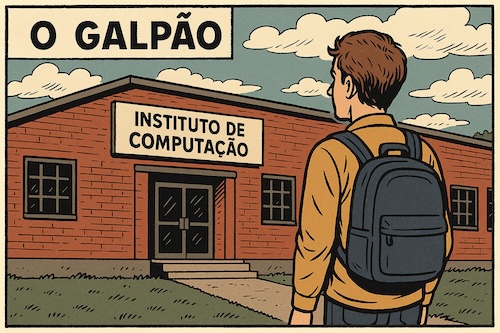
When I finished my undergraduate degree at UFMG, I ended up graduating in the middle of the year because of a semester I’d spent with my family in Canada. UFMG’s master’s program in Computer Science only admitted students at the beginning of the year, so I’d have to wait six months — and I really wanted to leave home, earn money, and move on. I looked for alternatives and found two options that accepted students mid-year: USP and Unicamp (both are usually near the top of Brazilian university rankings, especially in Computer Science). I applied to both, was accepted at Unicamp, and decided to move to Campinas.
Close to the start of the second semester of 1996, I boarded the bus to Campinas. The ride lasted all night, about 10 hours. I arrived in the morning at the bus station in a city I had never seen before, and I needed to figure out how to get to the Unicamp campus. Remember, this was 1996: before Google Maps, cell phones, and GPS.
Stepping out of the station, I asked around and was told: “You need to take the bus that goes to the Barão Geraldo bus terminal.” I would soon discover that the campus was located in the Barão Geraldo district, pretty far from downtown. I spent quite a while wandering around the bus station area, but I eventually found the bus stop. Once again, I conquered my shyness, talked to people, and figured out I’d have to transfer lines at the terminal. The ride was long, but I finally made it to the campus. Now I just had to find the right building. Soon I saw a sign pointing to IMECC (the Institute of Mathematics, Statistics and Scientific Computing). I went there and walked into a nice building, with a modernist architectural feel.
When I finally managed to find the graduate studies office, they explained: “It’s not here. It’s at the Institute of Computing. Follow this street a bit further.” I dragged my suitcase up the hill until I found the building of the Institute of Computing — a converted warehouse, plain and charmless, a complete contrast to the modern Mathematics building. The Institute has since moved to a much nicer new building, but that only happened after I graduated and moved away.
I went in, was welcomed at the graduate studies office, enrolled, picked my classes, and talked with the graduate program coordinator. Everyone was kind and attentive. Since I had my suitcase and backpack, they let me leave everything in their office while I moved around to deal with paperwork in other buildings. And that’s how I started getting to know the campus: on foot, asking for directions, looking at paper maps, searching for the cafeteria, and calling from the payphone whenever I needed to talk to someone back home.
The graduate studies office was a hangout for students; everyone passed through there. Some of them noticed I was new and came over to chat, say hello, and tell me what they were working on in their master’s or PhD programs. By the end of the day, I had to find a place to spend the night, but that’s a story for the next chapter.