The Musical Suitcase
While I was working, I was also trying to keep going with the PhD. Do you remember it? It wasn’t easy to juggle work, family life, and research. There were moments when it seemed like there simply wasn’t enough time, but I kept trying.
I read papers, exchanged emails, and had calls with my advisor. Every now and then, I went to Campinas to talk to him in person. Progress was slow, but there was progress. We managed to publish some papers at conferences, both in Brazil and abroad. Most of the time, I used vacation days or asked for permission at work to present the papers. That had been the pattern since I was still in Lavras. Over the years, I attended conferences in the United States, in Spain, in São José dos Campos, in Florianópolis, and elsewhere.
In 2004, while I was still working at BRB, there was a conference on multi-agent systems in Philadelphia, and our paper on Optimistic Blinded Key Signatures was accepted. I had already been to New York for Intelligenesis, so I decided to take advantage of the trip and spend a few days there. I planned to spend a week in Philadelphia for the conference and then another week in New York on my own. My advisor had funding to cover the flights and lodging during the conference.
When I arrived at the hotel in Philadelphia, the complications began. The hotel couldn’t process the charges on my Brazilian credit card. I called the bank and Gisele several times trying to understand why the transaction was being declined. At one point I thought they were going to kick me out, but in the end it worked out and the payment was accepted.
The conference was interesting. I met researchers and students from the field and took the opportunity to see a bit of the city. When it was over, I took the train to New York. Before that, though, a quick side note: when a Brazilian goes to the United States and sees how much things cost, they tend to buy everything they come across. In my case, the mission was to bring trinkets and toys for my kids. Gisele and I went to the Amazon website, bought a bunch of stuff, and had it delivered to the hotel where I was staying in Philadelphia.
When I got there and they handed me that pile of boxes, I realized I was going to have a problem taking it all back. I had a big suitcase, but the packaging took up much more space. I spent hours taking the toys out of their boxes to save space and fit everything in. The suitcase became absurdly heavy. Getting it onto the train was a serious effort. The funniest detail was that, whenever the suitcase got jostled, some toy would get triggered and start playing music. Still, off I went by train from Philadelphia to New York with my musical suitcase.
Hotels in New York were very expensive for our budget at the time (and still are today, by the way). I looked for alternatives and some friends suggested staying at the YMCA. The accommodations were simple, but much cheaper than regular hotels. They’d recommended the location in Manhattan, near the United Nations headquarters, but I found another one in Brooklyn, in the Greenpoint neighborhood, near a subway station. Since it was cheaper, I went with the Brooklyn one.
I got off the train at Penn Station and took the subway to Greenpoint. The area was a bit run-down, but there was a police station across from the hostel, which at least gave a sense of security. The room was tiny and the bathroom was shared. As a precaution, I brought my flip-flops to shower with. I still joke that it was a five-cross hotel, in contrast to the four stars of the conference venue.
I spent a week in New York. I visited museums, walked around the city a lot, and kept buying the items on the list. At one point, I had to buy an even bigger suitcase to be able to carry everything. Since the YMCA stay wasn’t exactly comfortable, I decided to shorten the stay and spend the last night at a hotel in Newark near the airport. At that time, internet access was still complicated, and the solution was to go to the New York Public Library on Fifth Avenue, where you could use computers with free internet access by appointment. From there I managed to book a night at a hotel near the airport and check how to get there.
At the hostel, there was no TV in the room, so I had little contact with the news. I’d grab the free newspapers handed out in the subway or left on the benches. In one of them, I read about the possibility that a hurricane might hit the United States in the coming days. I didn’t pay much attention, since it didn’t look like it would reach New York.
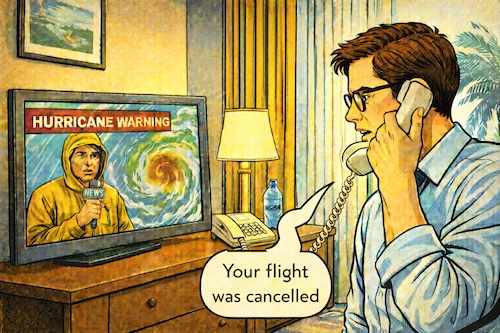
On the next-to-last day of the trip, I packed the bags and headed to the hotel near the airport. The suitcase was extremely heavy. A fellow guest at the hostel helped me down three flights of stairs. Then I made my way by subway and train to the hotel. The room was much nicer, with a private bathroom and a TV. When I turned on the TV, I saw CNN’s classic hurricane coverage, with reporters standing in the rain and wind. That’s when I realized the hurricane was affecting Miami directly. My return ticket was from New York with a connection in Miami before continuing to Brazil. At that moment I realized: maybe I wouldn’t be able to board the next day. I called the airline. The answer was straightforward: Miami airport was closed indefinitely. I’d have to wait for it to reopen to rebook the flights. They told me to call back the next day.
It was confirmed: I wouldn’t be going home on the planned date. I went to the hotel reception to try to extend the stay, but there was no room available. The hotel was fully booked. I had an immediate problem: where I would sleep the next night. The area had several hotels from popular American chains. Next door was a Motel 6, the kind you see in movies where the car stops right in front of the room. I went there and got a room for the next day. I switched hotels, went back to New York to visit the Museum of Natural History, and that night I called the airline again. Miami airport was still closed.
On the third day of waiting, with hotel rates and meals in dollars piling up (a hurricane hitting our bank account, as Gisele put it), I decided to go to the airport to try to resolve the situation in person. At the check-in counter, obviously, they didn’t let me board. The attendant suggested I call the airline’s call center and ask for rerouting. I went to a payphone, called, and got a flight with a connection in Boston. I went back to the line and, by coincidence, was helped by the same person. He tried to check me in, but the system wouldn’t allow it: the connection in Boston was too tight and there wouldn’t be time to transfer the luggage. I had to call again.
On the second attempt, the attendant found a flight via Dallas. There was an airport change in São Paulo, and the attendant hesitated a bit before booking it. I started thinking that, if I had to spend a few days in São Paulo or even take a bus to Brasília, that’d be no problem. In the end, she found a combination that worked: flight via Dallas, airport change in São Paulo, and final destination Brasília. I went back to the line one more time and was helped, again, by the same clerk. He managed to check me in, but my suitcase was overweight. Since it was the third interaction with him, I guess he decided to give me a break and let it go. And so my musical suitcase departed.
After a connection in Dallas and the airport change in São Paulo, I finally made it safely back to Brasília. By then, the PhD was already drawing to a close. But that’s a story for another chapter.