Off We Go!
It was November 2011, and, as I’ve already mentioned, I was in Beijing when I got the news that I had been selected for a position at the UN in New York. After going through the whole process and waiting months for a response, it had finally happened! I went back to Brazil and focused on the next step: submitting all the documents required by the UN. That included everything from medical examinations to personal documents, like passports, plus proof of my education and employment over the past 10 years.
Right at the start, I noticed an important point in the instructions: all the documentation had to be submitted in one of the UN’s official languages (English, French, Spanish, Russian, Arabic, or Chinese). Documents in Portuguese would not be accepted. That created a big problem for me. I had studied at Brazilian public universities and worked at government agencies, and they did not issue documents in other languages. I got in touch with the UN’s HR to ask if I could submit sworn translations. The answer was that the documents — and any translations — should be sent directly by the institutions. That was one of the first cultural shocks: in the United States, this is common, but in Brazil, documents are handed to the person, who is responsible for forwarding them.
That created an impasse: Brazilian institutions didn’t want to issue documents in another language or send them directly to the UN, while the UN wouldn’t accept documents sent or translated by the candidate. In my case, that affected both proof of my education and proof of my work experience at the Central Bank and the Chamber of Deputies.
I spent a few sleepless nights trying to find a solution. I even thought I might miss this opportunity because of this bureaucratic impasse. Then I had an idea: ask the people in charge at the institutions to send the documents in Portuguese accompanied by a letter in English attesting to their content. I got in touch with the coordinators of the programs where I had studied. Luckily, both had been my professors and knew me, so they agreed to help. They only asked that I prepare a draft of the letters. It wasn’t an official document from the institution in English, but a signed letter confirming the information.
After solving the academic side, I applied the same strategy to the proof of employment. I asked the managers of the areas where I had worked to sign letters in English confirming the information from the official statements. To simplify things, I collected everything myself and took it to post offices near the institutions so it could be sent from there. It was the closest I could get to the model required. After that, all that was left was to hope the UN would accept it. And they did!
Meanwhile, Gisele and I needed to sort out our professional situation. As I mentioned earlier, I could request unpaid leave to work for an international organization. That’s what I did. For Gisele, it would be leave to accompany a spouse relocating abroad, which is usually simpler. The problem was that these processes are slow. In my case, there was also a lack of precedent at the Chamber, in addition to legislation tailored to the Executive branch. I filed the request based on the existing decrees and waited. Since it was something new, the process took a really long time.
After the UN validated my documentation, we began the process of requesting visas at the U.S. Embassy in Brasília. I expected that to take weeks, given how hard it was to schedule appointments for tourist visas. To my surprise, within a few days I got instructions to go to the embassy any afternoon, bringing the passports and the documents provided by the UN. When I got there, it was totally empty, in sharp contrast to our experience requesting tourist visas, though those appointments were usually held in the morning. I showed the paperwork to the security guard, went in, was seen quickly, and was told to come back the next day to pick up the visas. It was a surprisingly simple and fast process.
I asked for three months before starting the position. That would give us time to organize the move and sort out pending matters in Brazil. It was an intense period. While still working, we had to deal with the leave requests, rent out the house, sell furniture, and select what we would bring with us. The UN offered to either pay for the move or provide a stipend. We opted for the money, since we’d be leaving a large house in Brasília for a likely smaller apartment in New York. We held a garage sale and got rid of almost everything. Gisele managed to rent the house to a colleague who was just starting at the Central Bank.
The UN sent the tickets: I’d fly in early February 2012, two days before my birthday, and Gisele would come with the kids 15 days later. That would give me a little time to find a place for us to live.
As the date approached, there was still no response from the Chamber about my leave. I took vacation and used up all my overtime hours, which gave me a little over a month. I asked them to speed up the process, but I knew it wouldn’t make much of a difference. I ended up boarding without knowing whether the request would be approved. Gisele got three months of training leave, during which she’d take an English course to prepare for the job market in New York.
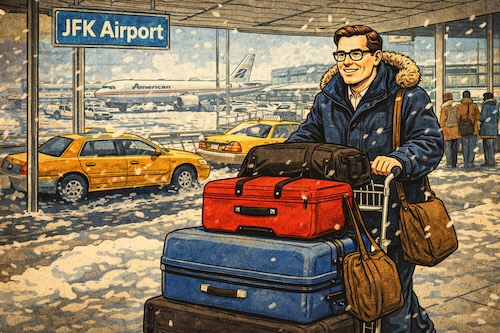
Almost three years after starting my search for an international position, I boarded a flight to New York alone to take on my new job. That marked the beginning of a new phase of my professional and personal life. But that’s a story for another chapter.
Notes:
- The title of this chapter is a catchphrase I like to use when talking about travel, inspired by the cartoon The Impossibles.